
Embodied Carbon Limits On End Products
Thresholds on embodied carbon applied to consumer products (e.g. a car or a building) taking into account embodied carbon (or as part of a wider metric together with operational carbon) in the whole product.

Embodied Carbon Limits On End Products
This policy is technologically neutral, allowing the use of a range of multiple decarbonisation levers to meet the thresholds. Key design choices include:
- Identifying suitable lead markets for green products.These should represent a significant share of demand with end users that can feasibly absorb the green premium - and ideally have customers with a sufficient willingness to pay for a green product¹.
- Defining intensity limits. These could either be set against baselines of existing end products (e.g. a percentage reduction versus a baseline at a given date)or be based on a threshold (e.g. limiting the kg CO2₂e/m² emissions embodied in a new building).
1: Agora Industry (2024): Creating markets for climate-friendly basic materials. Potentials and policy options sets out criteria to identify lead markets in detail
Demand creation potential rating by sector
We have developed an indicative rating of the green demand creation potential of each policy by sector, based on the share of demand it can apply to, and its potential impact on a business case. Depending on local/national context this may be more or less impactful indifferent sectors. We assess embodied carbon limits in end products as the highest priority in the aluminium, cement and steel sectors.






Key Attributes: Embodied Carbon Limits On End Products
Carbon leakage risk
Carbon leakage risks can be mitigated by accounting for emissions embodied in imported materials, but may impact the competitiveness of exports of select products. For sectors where end products are internationally traded (e.g. the automotive sector), businesses could shift production or procurement of products to other jurisdictions with less stringent environmental regulations.
Technology agnostic
Because carbon intensity limits are set on end products in this case, there are various means in which the limits could be achieved, e.g. by substituting intermediate products, using green input materials or using inputs more efficiently.
Ability to ramp up over time
Limits on embodied carbon can be phased in and tightened over time as solutions for deep decarbonisation become more affordable and available.
Burden of cost
Companies and consumers bear the burden of incurring additional costs that come with procuring lower-carbon end products. This could disproportionately impact smaller businesses, or industries with lower margins, or consumers that are less able to absorb these costs.
Long-term stability
Embodied carbon limits can be set with a long-term horizon, thus incentivising long lasting changes in the industry as it switches to greener methods of production.
Complexity
The major complexity lies around the volume of individual end products that the policy would need to set requirements for. Furthermore, governments need robust systems in place to support: emissions reporting; measurement; monitoring; enforcement; and to analyse and mitigate the impact on industrial competitiveness and social objectives (e.g. housing costs).
Sources: BloombergNEF, Agora Industry

Deep Dives & Case Studies
Decarbonisation levers incentivised by policy
In addition to the following decarbonisation levers, construction industry companies can consider other levers such as design optimisation, material substitution, digitisation and opting for energy efficiency equipment.
(see lever details in Annex 1)


1: Steel & Cement, Aluminium - Efficiency of use: optimising the use of material and reducing waste to reduce embodied carbon of a building
2: Aluminium: because aluminium only accounts for a small share of construction emissions, the impact on the aluminium sector is likely to be less pronounced
3: Aluminium - Low/near-zero carbon primary production: adopting production technologies with a lower carbon footprint (e.g. using clean power for aluminium smelting, inert anodes and/or mechanical vapor recompression (MVR))
Key considerations
- Whole lifecycle of projects: ideally carbon intensity limits should consider the whole lifecycle of construction projects, including the production and sourcing of materials, the construction phase, use and maintenance, through to end of life, as well as a project’s overall resiliency and durability.This can avoid unintended negative consequences, such as increased long-term emissions as a result of material substitution or reductions in overall lifespan of buildings.
- Physical scope: when introducing limits on the carbon involved in construction, it is key to define the physical scope involved consistently, so that like-for-like comparisons can be made between construction projects.
- Financial cost to end users: low and near-zero carbon materials command a premium, resulting in a modest increase in consumer prices (e.g. we estimate using 10% green materials could increase a typical house cost by approximately 1% in 2030). This could be in tension with social and housing objectives, particularly in markets where house prices are already high, or for social housing. Regulations could be paired with financial support to reduce these risks.
- Enforcement: a regulatory body is needed to oversee compliance by building developers. It may be costly and time consuming for some organisations (e.g. SMEs) in the construction value chain to demonstrate the environmental performance of their products. Tools to streamline these processes, and/or financial support may be necessary to support the creation of EPDs or other means of verification.
- Risk aversion: it may take time to develop new regulations as important traditional criteria (e.g. strength, durability and safety) need to be maintained.
- Standardised reporting and certification: these are essential to support the procurement of lower carbon materials and understanding their environmental impact, particularly compared to their substitutes (e.g. steel versus timber).
Sources: BloombergNEF, European Commission, Agora Industry (2024): creating markets for climate-friendly basic materials. Potentials and policy options. McKinsey & Co
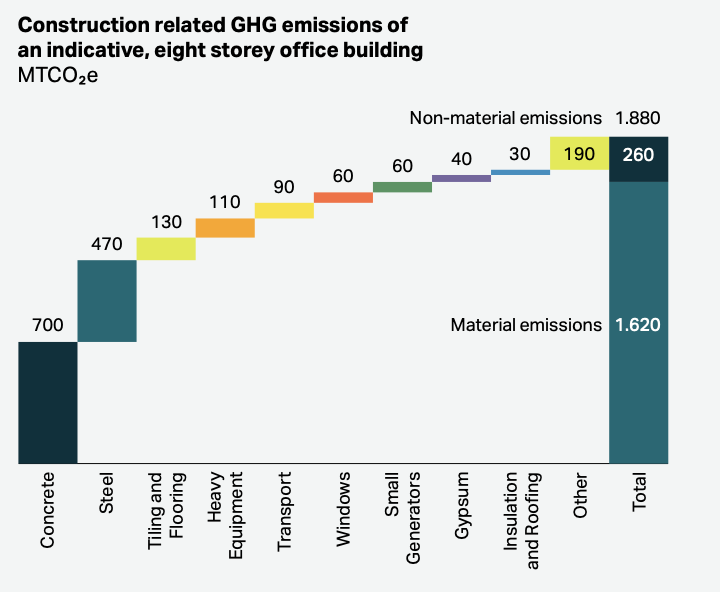
Source: Figure adapted from McKinsey & Co and Energy Transitions Commission for MPP:
Net-zero steel in construction: The way forward


Case study: RE2020 (Environmental Regulation 2020)
Examples of key enabling initiatives/ detailed studies
Decarbonisation levers incentivised by policy
(see lever details in Annex 1)
1: Steel & Aluminium - Efficiency of use: optimal use of the material in vehicles, reducing waste where possible, to reduce the overall embodied emissions
2: Aluminium - Low/near-zero carbon primary production: adopting production technologies with a lower carbon footprint (e.g. using clean power for aluminium smelting, inert anodes and/or mechanical vapor recompression (MVR))
Key considerations
- Adoption status of embodied carbon limits in the automotive sector: though embodied carbon limits have not yet been adopted that encompass all materials in a vehicle, the revised CO2 regulations for cars in the EU proposes to allow Low Carbon Steel credits to contribute to electrification targets.
- Policy design: embodied carbon limits could be incorporated into existing CO2 emission performance standards for vehicles by type (e.g. light, medium and heavy-duty vehicles). In order to avoid carbon leakage risks, legislation would need to apply to both domestic and imported vehicles.
- Scope: although the automotive sector could be an ideal lead market for green metals, for non-electric vehicles, most of the life cycle emissions will be operational (i.e.from combustion of conventional road fuels). Therefore, if operational and embodied carbon are considered in one limit, material reduction levers will only be a small part of this. To effectively drive demand for greener materials, this could be based instead on embodied carbon, or % use of low carbon metals alone.
- Implementation over time: the limits can be gradually tightened to give manufacturers time to adapt and allow for the production/availability of inputs to scale as well.
- Substitution: due to increased costs of specific materials (e.g.steel) regulations may drive substitution with other materials (e.g.aluminium) that are also typically lower carbon. It could also result in increased lightweighting of vehicles, which would also result in decreased emissions.
- Lead markets: limits could be specifically set on premium submarkets (e.g. luxury cars) where there may be more ability/willingness to pay for lower carbon products.
- Complementary policies:
- Lower carbon material labels and standards: Robust product standards and emissions accounting methodologies need to be in place to underpin embodied carbon limits. Clear labelling of products can also ease the process of procuring lower carbon materials for car manufacturers and help them navigate production pathways and associated emissions.
- Financial support and carbon pricing: while the cost impact to consumers may be relatively low (e.g. €57 or $62 a vehicle), green steel may cost 20-50% more for car manufacturers. Subsidies and carbon pricing can also play a role in bridging the green premium between grey and green steel.
Sources: Low Carbon Vehicle Partnership, ICCT, McKinsey & Co

3: Figure adapted from McKinsey &Co, The race to decarbonize electric-vehicle batteries indicative sizing based on EV embodied carbon being ~60% higher than an ICE vehicle. This does not account for recycling of materials
Sources: Low Carbon Vehicle Partnership, ICCT, McKinsey & Co