
Demand-Side Subsidies & Tax Credits
Payments given to buyers and consumers, reducing the price they pay for materials or fuels.

Demand-Side Subsidies & Tax Credits
These are payments given to buyers and consumers, reducing the price they pay for materials or fuels. Tax credits are financial benefits that reduce the amount of tax owed for producing or procuring a lower carbon material or fuel. They can be applied at the demand- or supply-side. This lowers post-tax costs and stimulates demand. In some cases, these can be higher than the tax paid initially - resulting in either a net rebate or limit on the tax credit provided.
A key limit on the scalability or potential impact of subsidies is ensuring sufficient funding can be made available. Funds can be raised via general taxation, or the proceeds of carbon pricing systems. Furthermore, significant subsidies are currently provided for the production and use of fossil fuels or fossil-based products.
There are opportunities to redistribute such subsidies towards lowercarbon products. For example, in India, approximately $30bn of subsidies wereallocated to the fertilisersector (FY 22-2023). Redistributing,or introducing requirements to use clean commodities into, such subsidies couldbe one way of incentivising green fertiliser use without an additional cost togovernments. A similar structure has been proposed under the EU IndustrialAccelerator Act which proposed to introduce requirements to use low carbonsteel and aluminium to select public support schemes.Subsidies could also be leveraged to achieve other strategic aims (e.g.building domestic capabilities in green markets, improving the national balanceof payments for fossil importers, and reducing exposure to the volatility ofglobal energy prices). Supply-side subsidies, (e.g.results based payments or for reducing capital expenditure) can also beleveraged to reduce production costs over the lifespan of productionfacilities.
There are many different models to provide Demand-Side Subsidies and Tax Credits to suppliers and users of deeply decarbonised commodities. A non-exhaustive set of models, many of which can be applied either on the demand- or supply-side, are set out below:
- Incorporation of clean commodity subsidies into existing schemes Where end products are already subject to subsidy schemes (e.g. fetilisers or cars), existing subsidies could be made conditional on using clean inputs, or additional subsidies could be administered as a bonus. Example: Proposed EU Industrial Accelerator Act measures on public support schemes
- Upfront grants: Paid upfront on a one-off basis or according to a payment schedule. Because these are one-off, they are particularly well suited to research and development (R&D) projects. Example: Grant funding via the EU innovation fund
- Tax credits: Reduction of tax liability for producing low carbon materials or fuels, which effectively decreases the costs incurred for procuring these products. Examples: Brazilian Hydrogen tax credits
- Fixed premium subsidies: Provide a fixed payment per unit output over a set period of time to all users of low carbon or near-zero commodities that meet a given standard. These subsidies can also be auctioned and awarded on a competitive basis (e.g. based on lowest subsidy needs). Example: European Hydrogen Bank
- Contract for difference: Provides subsidies that cover the difference between a fixed strike price and the price the commodity is sold at. If the reference price is lower than the strike price, there could be an obligation to pay the government back. Example: UK Hydrogen production Business Model, India SIGHT programme
- Carbon contracts for difference (CCFDs): Can only be implemented in conjunction with an emission trading system. Provides a contract for difference based on a pre-agreed carbon price reference, which is indexed to energy costs. Example: German Carbon Contracts for Difference
- Indirect subsidies: Subsidies provided on an indirect basis (e.g. by crediting the use of low carbon fuels with allowances in an emission trading system, or allowing the use of sustainable fuels to opt in to a fuel standard programme). Example: EU provision of free ETS allowances for airlines using SAF
The use of state-backed intermediaries can provide a means to both subsidise and de-risk offtake and the production of decarbonised commodities. Furthermore, other forms of tax relief and incentives could be provided in return for the use of low and near-zero commodities.
Demand creation potential rating by sector
We have developed an indicative rating of the green demand creation potential of each policy by sector, based on the share of demand it can apply to, and its potential impact on a business case. Depending on local or national context this may be more or less impactful in different sectors.
Demand-Side Subsidies are most critical for sectors where the green premium is especially high, and where certain consumers may not have the ability to afford to pay the green premium (e.g. fertilisers for farmers). Subsidies are especially important in certain segments of sectors to avoid adverse distributive impacts (e.g. subsidising shipping fuel for small island developing states that are heavily dependent on imports).






Key Attributes: Demand-Side Subsidies & Tax Credits
Carbon leakage risk
Since subsidies and tax credits reduce the cost of using low and near-zero commodities, they do not pose significant carbon leakage risks. They can be used to mitigate the competitive risks associated with mandatory measures and carbon pricing.
Technology agnostic
Subsidies and tax credits can either be targeted at specific sectors or technologies, or be applied based on a technology neutral basis.
Ability to ramp up over time
As the supply of decarbonised commodities increases and costs drop, subsidy programmes can be calibrated to account for greater coverage - and creates the potential for reduced levels of subsidies.
Burden of cost
They would need to be funded by governments, and this could amount to a significant sum. Allocation of funds could be made more efficient by running competitive processes for support - see next slide. Additionally, where subsidies are currently being applied for fossil- based products and fuels, these could be redistributed to lower carbon options.
Long-term stability
Current subsidy programmes offer incentives either upfront or over 10-15 years. However, renewing and capitalising these programmes is subject to government budget cycles, which can be significantly shorter. This makes it difficult to be certain whether subsidies will be in place for the long term.
Complexity
Given the low competitive distortion risks associated with subsidy programmes and tax credits, these are likely to be less complex to implement.

Deep Dives & Case Studies
Decarbonisation levers incentivised by policy
(see lever details in Annex 1)


1: Steel & Aluminium - Efficiency of use: optimising the use of material and reducing waste (depending on size of subsidy)
2: Aluminium - Low/near-zero carbon primary production: adopting production technologies with a lower carbon footprint (e.g. using clean power for aluminium smelting, inert anodes and/or mechanical vapor recompression (MVR))
Key considerations
- Stage of the value chain: subsidies for the use of green materials could be applied at various stages of the value chain. To administer them efficiently, it may be prudent to ensure demand-side subsidies are applied at a large enough scale to support new supply. Therefore, demand-side subsidies may need to be provided to a) very large offtakers b) consortia of end users c) to localised hubs or d) disbursed via existing subsidy schemes.
- Technology pathways: subsidies can either target the procurement of material using specific production pathways(e.g. use of CCUS in production) or be technology neutral, targeting the carbon intensity of a material - see example ofCCFDs. The former is especially useful if policymakers wish to scale specific nascent technologies and meet broader goals such as developing new green markets and supply chains. However, policymakers may risk artificially selecting technology ‘winners’ and may not allocate funding to the most efficient technologies in the near term.
- Implementation over time: the criteria for products eligible for such subsidies can be tightened over time, as costs of new solutions reduce, and as more novel technologies that can achieve deeper emission reductions mature.
- Complementary policies: subsidies can be paired with regulatory measures (e.g. mandatory quotas) to achieve a larger effect on emission reduction and reduce increased costs for end consumers. They can be applied at different parts of the value chain (e.g. subsidies for demand side and mandates for producers) or at the same stage. For subsidies, policymakers should assess the ability for various buyers to absorb the green premium across the value chain - and tailor the amount provided. Since they reduce the overall costs associated with green products, they can also help to mitigate carbon leakage risks. In the absence of sufficiently robust carbon pricing systems, subsidies can be key to help bridge the cost gap with carbon intensive goods.
Source: BloombergNEF: Scaling Technologies for Greening Heavy Industry

Case study: Carbon Contracts for Difference (CCFDs)
Decarbonisation levers incentivised by policy
(see lever details in Annex 1)
1: Steel & Chemicals - Efficiency of use: improving fuel efficiency by optimising routes, speed, and other operational practices
2: Aviation & Maritime - Efficiency of use: optimal use of products to reduce associated emissions
3: Maritime - SZEF: scalable zero emission shipping fuel (SZEF) and includes zero or near-zero emissions methanol and ammonia
Key considerations
- Policy design: a range of different subsidy instruments can be used to support projects depending on national priorities, government risk appetite, and the needs of industry. Given the differences between demand sectors, sector-specific subsidy programmes may need to be developed to ensure hydrogen consumption is scaled appropriately across different sectors (e.g. demand-side subsidies may be needed in the fertiliser sector to support farmers with tight profit margins to help buy green fertiliser, and to manage distributional impacts in other sectors like shipping).
- Co-ordination with other countries: for global transportation sectors (e.g. international maritime) where hydrogen derivative-based fuels are not drop-in replacements for fossil fuels, subsidies may need to be co-ordinated between countries to build demand and enable infrastructure investments across international networks.
- Potential to offset social and distributional impacts:although the costs of end products to end consumers in the value chain tend to be low, this could sometimes have a social or distributional impact. Increased food costs may be more difficult to absorb in emerging economies. Similarly, increased costs associated with low carbon shipping may distributional impacts effecting developing countries. Demand-side subsidies can be used to offset cost increases.
- Achieving scale and targeting different value chain stages: several demand-side subsidy instruments are targeting localised hubs, comprising multiple hydrogen demand sources to provide a large enough signal to support new production facilities.
- Complementary policies: demand-side subsidies could be used effectively in conjunction with a range of instruments (e.g. providing subsidies to reduce the cost of using green fertilisers could offset the impacts of regulatory measures such as mandatory quotas). In turn, leveraging mandates could increase the willingness to pay, reducing the government funding needed for subsidies.
Source: IEA
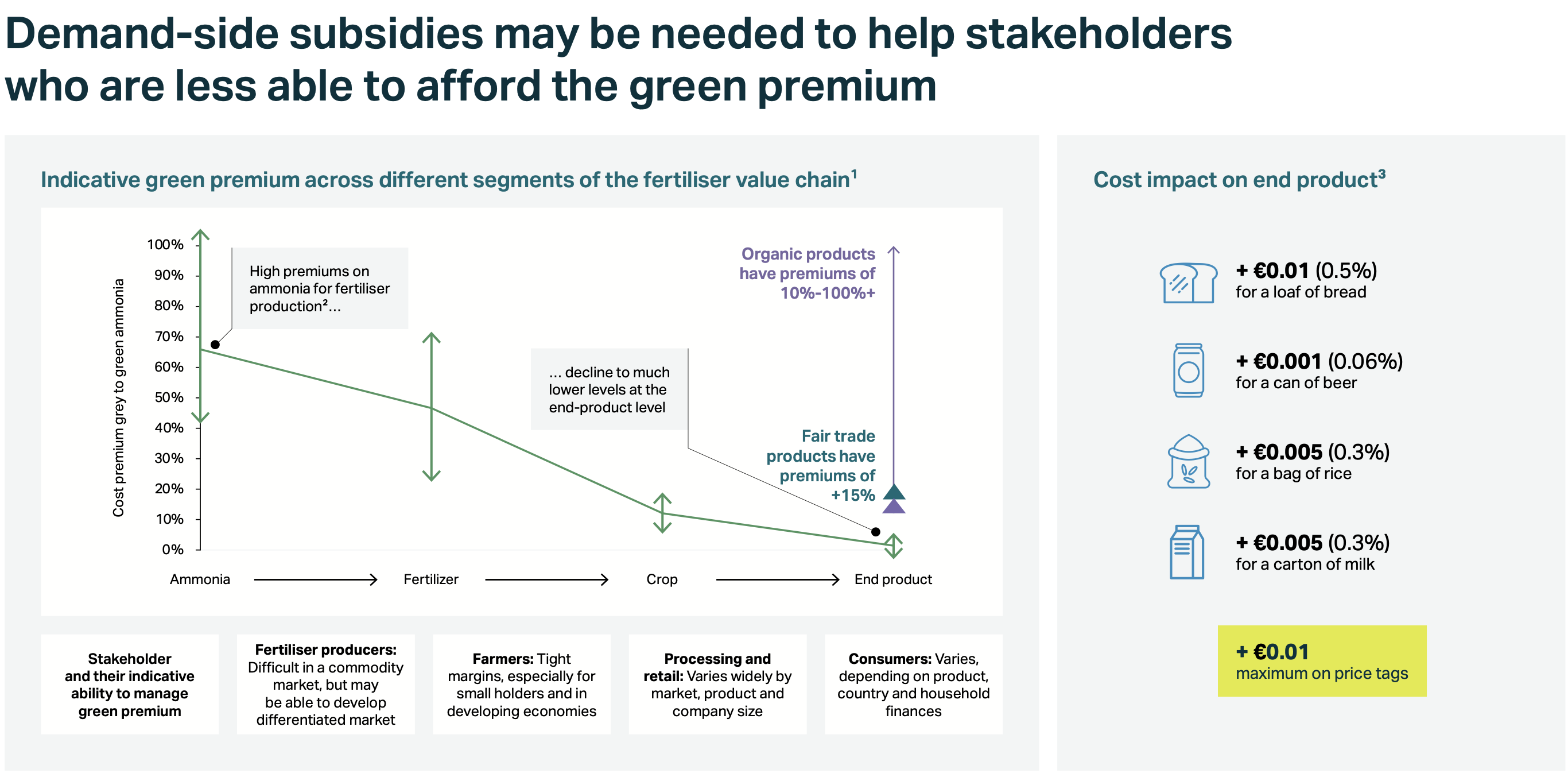
1: premium cascade estimates based on estimated percentage contribution of ammonia to fertiliser cost, fertiliser to crop cost and crop to end product cost
2: displayed premium is based on modelling of a 0.5MT plant placed in a region with affordable renewable energy to produce hydrogen (i.e. Sweden), starting operation in 2027, and fossil energy market price outlooks
3: based on approximate crop input volume to produce the end product
Sources: MPP analysis, Global Agriculture, BloombergNEF: Scaling up hydrogen: the case for low carbon ammonia, IEA: Global Hydrogen Review 2024
Case study: National Green Hydrogen Mission – Pilot Projects
Examples of key enabling initiatives/ detailed studies