
Carbon Pricing
A cost is applied to CO₂ emissions and other greenhouse gases. The cost reflects the external damages of these emissions.

Carbon Pricing
There are two overarching mechanisms for implementing carbon pricing:
- Cap and trade system: which caps the total amount of emissions allowed. Emitters need to procure permits for each tonne of CO2 they emit, which can be traded. This creates a market for emission permits and incentivises reductions.
- Carbon taxes: this directly sets a price per tonne of CO2emitted. Emitters must pay this tax, which incentivises them to reduce emissions to lower the resulting tax burden. While some carbon taxes are explicit (e.g.based directly on GHG emissions) others are implicit(e.g. applied to each unit of a given fossil fuel sold).
Some sectors, such as international maritime and aviation, will soon be (in the case of maritime) or are (in the case of aviation) subject to forms of international pricing systems.
Demand creation potential rating by sector
We have developed an indicative rating of the green demand creation potential of each policy by sector, based on the share of demand this lever can apply to, and its potential impact on a business case. Depending on local or national context this may be more or less impactful in different sectors.
We assess carbon pricing as an especially high priority for the aluminium, cement and steel sectors, as it can bridge the green premium more effectively than in aviation, maritime and chemicals. Nevertheless, carbon pricing can be effective in aviation, and maritime, especially paired with other measures such as demand-side subsidies to create a bigger impact on the business case.






Note: a multilateral measure for a GHG pricing mechanism is currently under developmentat IMO, which international shipping would be subject to and should be prioritised.Domestic systems could be applied to domestic shipping. A global market basedmechanism (Carbon Offsetting and Reduction Scheme) applies to aviation.
Key Attributes: Carbon Pricing
Carbon leakage risk
Heavy industry and international transportation sectors are subject to global competition and are at risk of carbon leakage. To mitigate this, these sectors are often shielded from carbon pricing systems. New models, like global carbon pricing systems in some sectors (e.g. aviation and shipping) and carbon border tariffs, are emerging to apply carbon prices while mitigating this risk.
Technology agnostic
Carbon pricing systems are often applied across multiple sectors. In a cap-and-trade system, emissions can be traded between sectors. This incentivises the cheapest and most near-term efficient ways to reduce emissions.
Ability to ramp up over time
As technologies mature, and underpinning infrastructure is put in place, it should be possible to set increasingly stringent carbon pricing mechanisms. However, higher carbon prices may meet political backlash and pose competitive challenges without complementary measures.
Burden of cost
The costs of carbon pricing would be borne by industry. Many governments redistribute the revenues raised from carbon pricing to support the transition through subsidies for green industrial players (e.g. funds from the EU ETS are recycled into the Innovation Fund¹).
Long-term stability
Carbon prices, especially market-based systems, can fluctuate depending on economic conditions, policy changes and technological improvements. Measures like price floors and ceilings can prevent extreme fluctuations. Long-term commitments, with progressively higher, stringent prices/more stringent limits on emissions, can create a stable trajectory.
Complexity
Carbon pricing is relatively complex to implement given: the broad scope; potential impacts on economic competitiveness; the need for integration with existing policies; the need to mitigate carbon leakage; and the risk of carbon price volatility.
1: Source: Innovation Fund

Deep Dives & Case Studies
Decarbonisation levers incentivised by policy
(see lever details in Annex 1)


Key considerations
- Risk of carbon leakage: a key challenge to implementing carbon pricing in heavy industry is that many of the sectors involved are subject to global competition. In particular, there is a risk that if commodities are internationally traded, producers could relocate to regions with a lower (or no) carbon price. This may result in higher emissions for creating these products, which could be imported back to the region with a carbon price - resulting in a loss of competitiveness and higher emissions. Potential options to mitigate this risk include global pricing schemes (e.g. WTO is initiating a taskforce on international co-operation on carbon pricing) and carbon border adjustments (see next section). If comparable carbon pricing schemes become more common, such measures may become less necessary.
- Economic competitiveness: because carbon prices increase the cost of commodities, they can make exports less competitive. Where a jurisdiction’s production of commodities are largely for domestic consumption, this may be a limited problem. One option to mitigate this risk could be rebates of carbon taxes for exporters.
- Carbon price stability: heavy industry is characterised by high upfront investment costs, and requires a degree of predictability of future cashflows to enable investment decisions. Carbon prices would need to be both sufficiently high and stable to enable emission reductions. Measures to stabilise carbon prices for heavy industry could include: tightening overall caps on emissions over time; introducing price floors for emission trading systems; and/or carbon price indexed subsidy mechanisms (see CCFDs case study).
- System scope: the scope of a carbon pricing system needs to be carefully designed to avoid disadvantaging novel technologies. Depending on system scope, it may be difficult to monetise specifice mission reduction levers (e.g. carbon dioxide removal via recarbonation of cement which takes place overlong periods of time). Where free allocations are provided, the detailed rules around their provision have sometimes disadvantaged low carbon options.
- Efficiency: carbon taxes may be set by governments on an economy wide or sector-by-sector basis. Cap-and-trade systems are market-based measures designed to maximise efficiency - ensuring the cheapest emission reductions are unlocked as prices progressively increase. Although this may yield economic efficiency in the near term, it may miss opportunities (e.g. to rapidly scale up low nascent technologies and achieve cost reductions) and risks carbon lock in (e.g. from fossil-based plants with long lifetimes). Complementary measures (like subsidies and regulations) can be used alongside carbon pricing to achieve this.
- Revenue recycling: the proceeds of carbon pricing systems can be recycled into subsidy schemes to support low carbon technologies.
Source: Hydrogen insight, Reuters
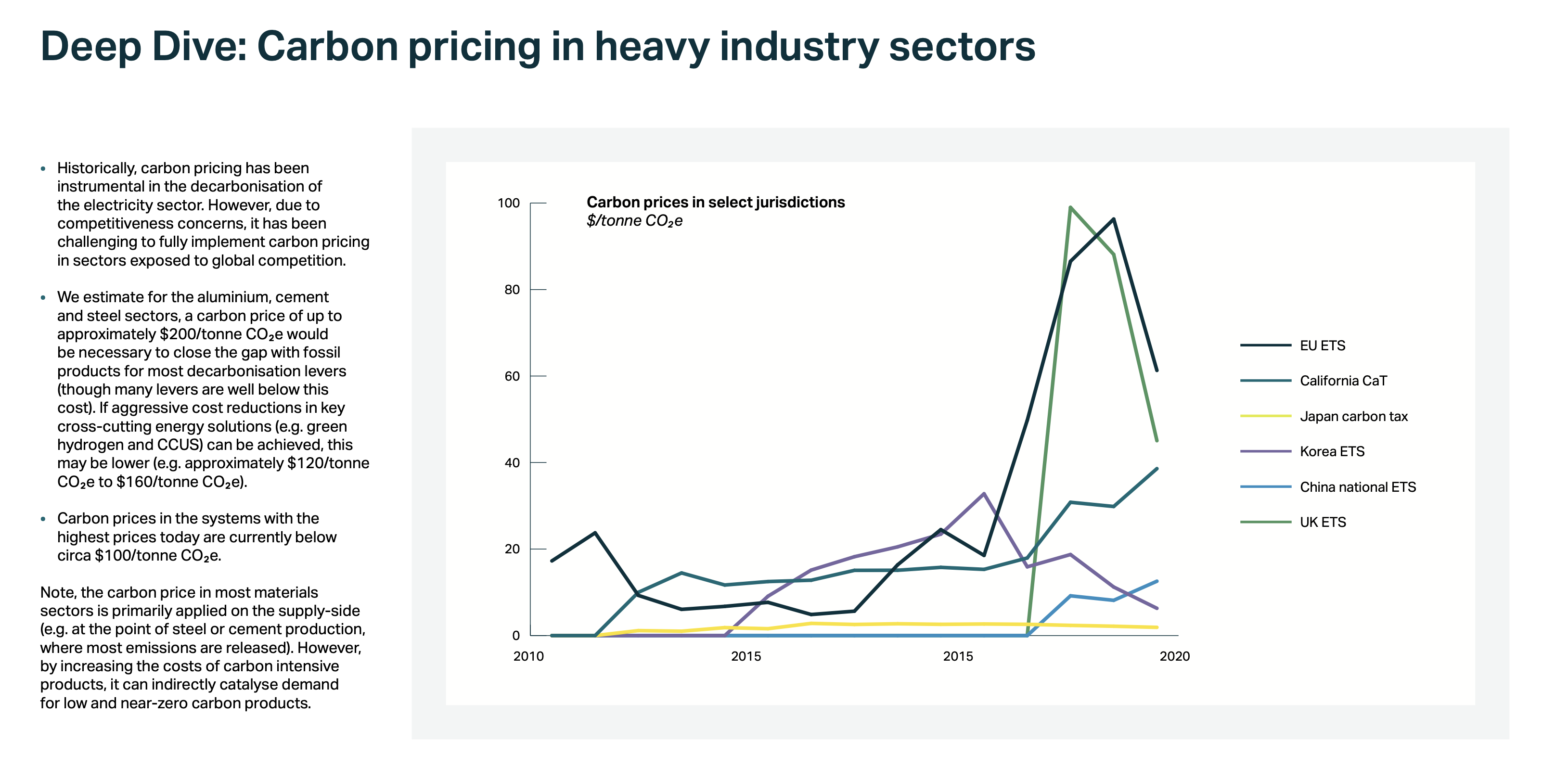
Sources: World Bank Carbon Pricing Dashboard, Agora Industry (2024), MPP Making net zero steel/aluminium/cement possible

1: although steel recycling is a low cost decarbonisation option with very high emission reduction potential, its scalability is limited by the supply of scrap and the potential need for virgin steel for certain cases
Sources: World Bank Carbon Pricing Dashboard, Agora Industry (2024), MPP Making net zero steel/aluminium/cement possible

Case study: EU ETS and CBAM
Examples of key enabling initiatives/ detailed studies